Fotona 4D vs Ultherapy vs Thermage FLX: Which Non-Surgical Facelift is Best?
💡 At a Glance: Executive Summary
Choosing between non-surgical facelifts depends on whether your primary concern is skin laxity (sagging), deep structural volume loss, or surface texture and fine lines:
- Ultherapy (HIFU): Best for deep structural lifting of the SMAS layer (jowls, submental chin, brow lift).
- Thermage FLX: Best for smoothing surface fine lines, skin crepeiness, and tightening the dermal layer (face, eyes, body).
- Fotona 4D / 5D: Best multi-layered treatment addressing skin texture, pigment, tightening, and nasolabial folds (via intraoral laser).
- Biostimulators & Fillers: Best for restoring lost facial fat and bone volume (midface flattening, deep hollows).
- Thread Lifts: Best for instant physical suspension of severe lower-face sagging without surgery.
The demand for non-surgical facial rejuvenation has exploded. With advanced technologies like monopolar radiofrequency, micro-focused ultrasound, dual-wavelength lasers, and collagen biostimulators, patients can now achieve remarkable tightening and lifting without plastic surgery.
However, navigating the jargons—Fotona 4D vs Ultherapy vs Thermage FLX vs Fillers—can be overwhelming. There is no single "best" device; rather, each technology targets specific anatomical skin layers and aging mechanisms.
Understanding the 3 Pillars of Non-Surgical Lifting
Facial aging occurs across multiple anatomical layers: bone reabsorption, fat pad displacement, dermal collagen loss, and laxity in the SMAS (Superficial Musculoaponeurotic System) layer. Effective non-surgical rejuvenation combines three core modalities:
- Energy-Based Tightening: Heat-induced collagen stimulation (Ultherapy, Thermage FLX, Fotona 4D).
- Volume & Biostimulation: Restoring lost structural support (Hyaluronic Acid, Sculptra, Radiesse, Profhilo).
- Mechanical Suspension: Physically lifting fallen fat pads (PDO / Silhouette Soft Thread Lifts).
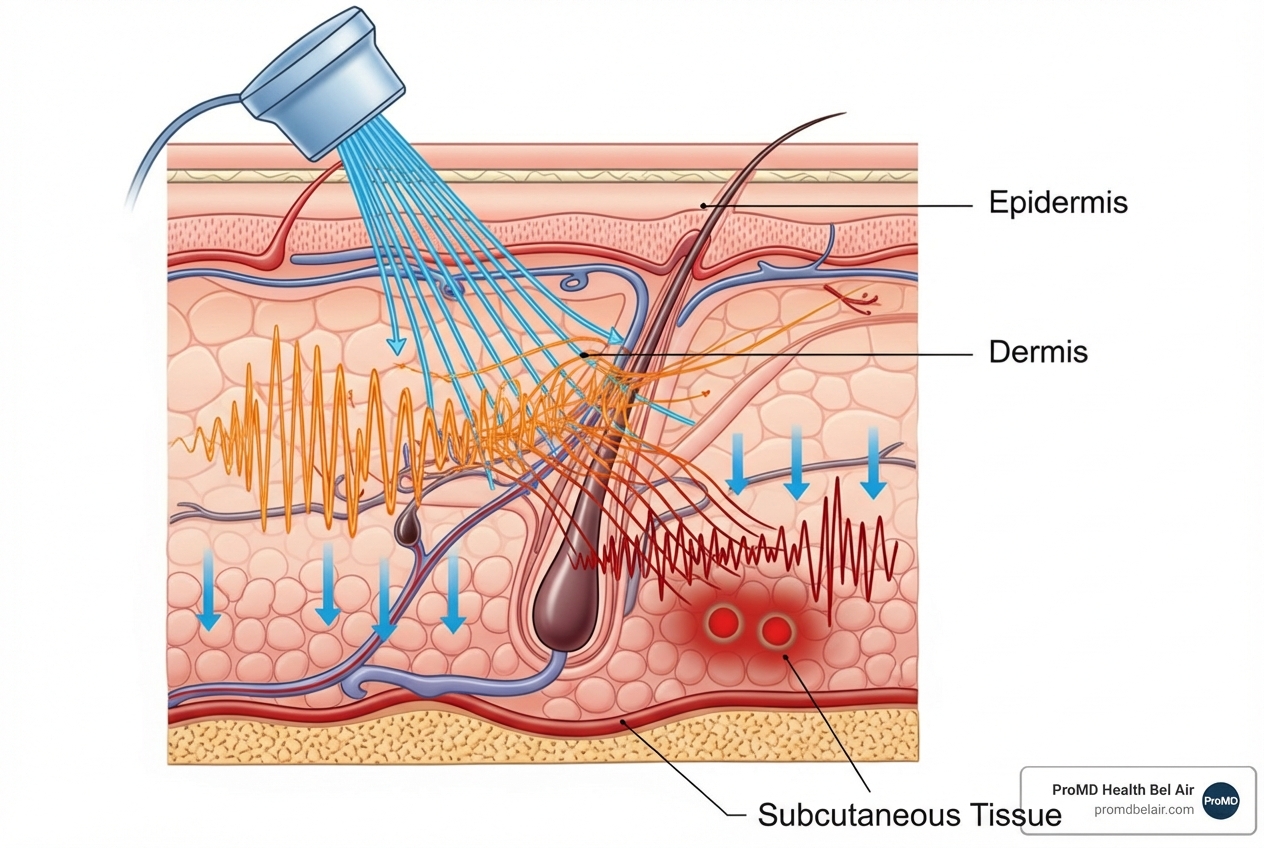
Diagram showing treatment penetration depths across Epidermis, Dermis, Subcutaneous Fat, and SMAS layers.
Master Comparison Matrix
1. Fotona 4D / 5D Non-Surgical Laser Lift
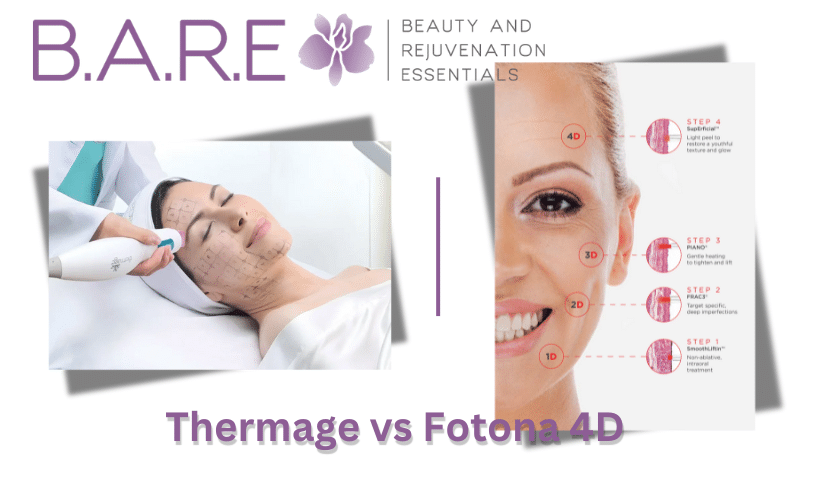
Fotona 4D® is a multi-step, non-invasive laser protocol combining two complementary wavelengths (Er:YAG and Nd:YAG) across four distinct modes to treat exterior facial skin and the interior oral cavity.
The 4 Steps of Fotona 4D Explained:
- Step 1: SmoothLiftin™ (Er:YAG) – Intraoral non-ablative heating inside the mouth to stimulate collagen, plumber nasolabial folds, and smooth perioral wrinkles from within.
- Step 2: FRAC3® (Nd:YAG) – Micro-fractional laser targeting deep dermal imperfections, pigmentation, and vascular flushing to restore youthful texture.
- Step 3: PIANO® (Nd:YAG) – Ultra-long pulse bulk tissue heating to safely tighten subcutaneous fat layers and deep dermis.
- Step 4: SupErficial™ (Er:YAG) – Light cold laser peel that removes surface dead cells, minimizes pores, and gives an instant pearlescent glow.
What is Fotona 5D / VectorLift®? Extended protocols like Fotona 5D add a 5th step targeting the hairline (VectorLift®) and posterior neck to create an upward anchor pull on facial ligaments.
Pros:
- Treats surface texture, pigment, pores, and deep laxity simultaneously.
- Unique intraoral treatment fills smile lines without injectable fillers.
- Comfortable procedure with minimal pain and customizable downtime.
Cons:
- Requires a series of 3 to 4 sessions for optimal results.
- Operator skill is crucial for custom energy delivery.
2. Ultherapy (Micro-Focused Ultrasound with Visualization)
Ultherapy® remains the gold standard for non-invasive deep structural lifting. It uses Micro-Focused Ultrasound with Visualization (MFU-V) to deliver precise thermal energy to depths of 1.5mm, 3.0mm, and 4.5mm (SMAS layer) without disrupting the skin surface.
By heating tissue to ~60–70°C, it creates precise micro-thermal coagulation points (TCPs) that trigger immediate tissue contraction and kickstart neocollagenesis over 3 to 6 months.
Pros:
- FDA-cleared to lift skin on the neck, submental (under chin), eyebrow, and improve lines on the décolletage.
- Real-time ultrasound imaging ensures safety and eliminates risks of fat necrosis or burns.
- Usually requires only 1 treatment per year.
Cons:
- Can be painful (feels like hot pricks or deep bone warm pulses).
- Does not improve surface skin texture, pigmentation, or fine pores.
- Not suitable for patients with extremely thin facial fat pads.
Comparison of surface vs bulk tissue thermal energy delivery between monopolar RF and multi-step lasers.
3. Thermage FLX (Monopolar Radiofrequency)
Thermage® FLX represents the 4th generation of monopolar radiofrequency (RF) technology. It delivers bulk 6.78 MHz RF heat into the deep, collagen-rich dermal layers while simultaneously cooling the upper epidermis.
Thermage FLX features AccuREP™ technology, which automatically tunes every energy pulse based on local tissue impedance for uniform collagen tightening and enhanced patient comfort.
Pros:
- Superior overall skin smoothing, tightening, and periorbital (around eyes/eyelids) rejuvenation.
- Single treatment protocol with zero downtime.
- Faster treatment time with the enlarged 4.0 cm² tip.
Cons:
- Does not reach the deep 4.5mm SMAS layer like Ultherapy.
- High treatment consumable cost.
4. Dermal Fillers & Collagen Biostimulators
Energy devices tighten tissue, but they cannot replace lost facial fat or bone structure. Liquid face lifts use structural dermal fillers and biostimulators to restore youthful contours:
- Hyaluronic Acid (HA) Fillers (Juvederm, Restylane, Belotero): Provide immediate volumetric lifting via advanced anchoring techniques (Hairline Lift, Ligament Tenting, Vector Lifts).
- Collagen Biostimulators (Sculptra / PLLA, Radiesse / CaHA): Injectables that act as a scaffold to trigger long-term native collagen growth, density, and skin thickness over 2–3 months.
- Bio-Remodeling (Profhilo, HarmonyCa): Ultra-pure HA or hybrid formulations that spread across skin layers to hydrate, firm, and remodel crepey skin texture.
5. Thread Lifts & Intradermal Dysport Dermalift
Thread Lifts (PDO / PLLA / PCL)
Absorbable barbed or cone threads (e.g., Silhouette Soft) are inserted under the skin into subdermal tissue to physically grasp and lift sagging fat pads upward. As the threads absorb, they stimulate a vector line of collagen formation.
Dysport Dermalift (Micro-Tox)
Originating in South Korea, micro-doses of Botulinum Toxin are injected intradermally (into the skin layer rather than underlying muscles). This stimulates dermal fibroblast contraction, shrinks pores, and provides a subtle, natural instant lift without a frozen look.
Head-to-Head: Which Should You Choose?
Fotona 4D vs Thermage FLX
Thermage FLX delivers uniform monopolar radiofrequency heat to the dermis, making it ideal for tightening thin, loose, or crepey skin. Fotona 4D offers a more versatile 4-in-1 approach that addresses pigment, surface roughness, and deep smile lines (via intraoral treatment). If you have surface texture issues alongside mild sagging, Fotona 4D is superior.
Ultherapy vs Thermage FLX
Ultherapy reaches deeper (up to 4.5mm SMAS layer) to deliver targeted focal heating points, making it the top choice for heavy jowls, submental chin fat, and overall structural lifting. Thermage FLX operates shallower (3.0mm) with bulk heating, making it better for fine surface wrinkles, eye area tightening, and overall skin smoothing.
🎯 Decision Guide Based on Your Face Type:
- Heavy/Full Lower Face with Sagging Jowls: Choose Ultherapy + lower face Thread Lift.
- Thin Face with Fine Wrinkles & Crepey Skin: Choose Thermage FLX + Sculptra / Profhilo.
- Sun-Damaged Skin with Nasolabial Folds & Uneven Texture: Choose Fotona 4D / 5D.
- Sunken Temples, Hollow Cheeks, & Flat Midface: Choose Structural Dermal Fillers.
Frequently Asked Questions
Can I combine Ultherapy, Thermage, and Fillers?
Yes! Combining modalities yields the best results. A popular combination protocol involves Ultherapy for deep SMAS lifting, followed by Thermage FLX or Biostimulators 1–2 months later for dermal collagen and volume restoration.
At what age should I start non-surgical facelift treatments?
Preventative skin tightening usually begins between ages 28–35 when collagen degradation accelerates. Structural lifting treatments (Ultherapy/Thermage/Threads) are most effective for mild-to-moderate laxity between ages 35–60.




.png)

Comments
Post a Comment